

406.587.4531
simmental@simmgene.com
406.587.4531
simmental@simmgene.com
A Better Fit: Heterosis and Breed Complementarity in the Updated $API and $TI
By Dr. Jon DeClerck., ASA Executive Vice President
For more than 20 years, the original $API and $TI served the breed well. But when it came to breed composition, the model was relatively broad. One general relative-emphasis framework was applied across cattle.
I think of it like reading glasses from the drugstore — they can work, but they rely on broad assumptions. The updated indexes work more like prescription glasses, tailored to the individual. The model now evaluates Simmental breed composition in 10% increments, allowing the relative emphasis on traits to change as breed composition changes.
That may be more complicated, but intuitively it makes sense. A purebred Angus bull, a half-blood Simmental bull, and a purebred Simmental bull are unlikely to contribute the same things when bred to Angus cows. The model can now better recognize those differences.
Putting a Value on Heterosis
This greater precision also allows the updated model to do something the old indexes could not do as well: more accurately account for the value of heterosis.
Angus-on-Angus produces no heterosis. Simmental-on-Angus does. On average, those crossbred calves should have a performance advantage across several economically important traits. The old model had a limited ability to capture that advantage. The updated model can account for heterosis more precisely across individual traits and better reflect its economic value.
That helps explain some of the re-ranking breeders are seeing, particularly among purebred Angus cattle. Those bulls did not suddenly become worse genetically. What changed is that the updated indexes can now better recognize the added performance and profitability that heterosis brings.
A Better Fit for the Production System
Crossbreeding value does not come from heterosis alone. It also comes from combining breed strengths in a complementary way.
Think about building a basketball team. You could have four outstanding three-point shooters in your starting lineup. But when you choose the fifth starter, another great shooter may not add as much value as someone who rebounds, defends, or is a great passer.
The question is not simply, “Who is the best player?”
It is, “Which player makes this team better?”
The original $API did a nice job of ranking the player. The updated $API does a better job of finding the right fit for the team.
Keep in mind that both $API and $TI begin with an Angus-based cow herd.
So the question is not simply:
How good is this Simmental bull?
It is also:
How does this Simmental bull complement Angus cows?
Angus already brings considerable strength in marbling and calving ease. A Simmental bull that excels in those same areas may still be excellent, but he could be duplicating strengths already present — much like adding a fifth three-point shooter.
Another bull may add more muscle, feed efficiency, or maternal value and be a better complement. Neither bull became better or worse genetically. The difference is fit.
The change in emphasis on marbling and ribeye area provides a good example of what breed complementarity looks like in the updated model.
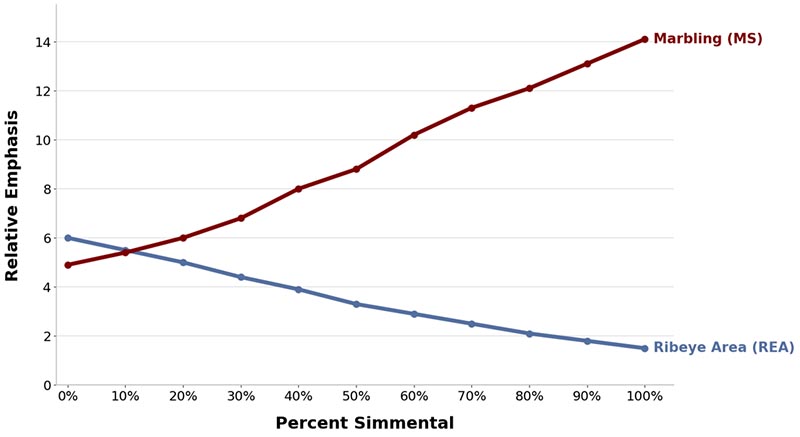
Figure 1. Breed complementarity changes relative emphasis. Angus are generally stronger in marbling, while Simmental typically have more muscle. The model rewards what is needed most: REA when breeding Angus bulls to Angus cows, while marbling becomes relatively more important as Simmental percentage increases.
Breeders Already Think This Way
Seedstock producers already understand this concept, even if they have never called it breed complementarity.
When a commercial producer calls looking for a bull, you ask questions. What kind of cows do they have? Are they keeping replacements? When will they market their calves? Where does the cow herd need to be improved?
The answers change which bull you recommend. Your “best” bull is not necessarily the best bull for every customer.
That is what the updated model is doing a better job of recognizing.
It also helps explain why some cattle moved after the research release. A bull that previously ranked extremely high in $API or $TI may still have tremendous strengths. His genetics did not change overnight; the updated model is looking less at how good he is on his own and more at what he adds to Angus cows.
That same bull could be a tremendous fit on a different cow base.
The bull did not change. The job description did.
Why Fit Matters
From the beginning, IGS has been built around a simple idea: breed associations are not competitors; they are crossbreeding partners.
The goal is not to make every breed alike. It is to use each breed’s strengths, capture the value of heterosis, and create more profitable cattle for commercial producers.
The old $API framework was closer to asking:
How good is this player, regardless of the roster around him?
The better question is:
Which player is the best fit for this team?
For Simmental breeders selling genetics to commercial producers, that is a question we already ask every day.
Now our indexes are doing a better job of asking it too
Subscribe to eNews ASA's weekly newsletter.
Sales Call: Calendar of upcoming sales and
eBlast: Sales and other industry promotions