

406.587.4531
simmental@simmgene.com
406.587.4531
simmental@simmgene.com
Building on Progress: Why It’s Time to Update $API and $TI
by Dr. Jon DeClerck, ASA EVP
Twenty years ago, the American Simmental Association (ASA) took an important step forward in how breeders used genetic information.
$API and $TI were first published in the Spring 2005 Sire Summary. At the time, Dr. Wade Shafer described economic indexes as a way to turn a growing collection of EPD into a roadmap for genetic progress. His analogy was simple: EPD without indexes were like superhighways without maps — you could move fast but not always know whether you were headed in the right direction.
That philosophy still holds today.
Over the last two decades, Simmental cattle have made tremendous progress in calving ease, marbling, growth, and carcass performance. $API and $TI helped encourage breeders to think beyond individual EPD and instead consider how multiple traits influence profitability across an entire production system.
During that same period, ASA registrations have grown by around 54 percent. That growth reflects many factors — breeders, commercial customers, improved genetic tools, marketing efforts, and changing industry demand among them. $API and $TI are only one part of that story, but they helped drive clear genetic progress and increase the demand for Simmental cattle in the commercial beef industry.
So why update $API and $TI? Because the industry around them has changed — and so have the tools available to us. Updating $API and $TI is not about moving away from what has worked. It is about building on that success with better data, better technology, and a better ability to model the biology and economics of today’s cattle industry.
New Traits Create New Opportunities
When $API and $TI were developed, ASA was already focused on economically relevant traits that directly influence profitability. The familiar $API pyramid reflects that philosophy, with factors such as cow herd intake, heifer pregnancy, carcass weight, feedlot intake, and salvage value included in the model.
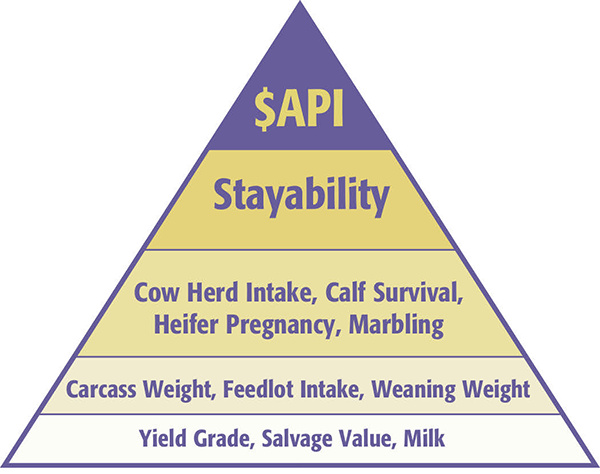
Figure 1. Original $API framework.
The challenge was that ASA could not directly predict those traits at the time. Instead, the indexes relied on known genetic relationships with traits such as growth and milk to estimate them indirectly.
Today, we can do more. In roughly the past year, International Genetic Solutions (IGS) has added Mature Cow Weight, Cow Energy Requirement, Heifer Pregnancy, Dry Matter Intake, and $Gain to the genetic toolbox. These advances allow more economically important traits — including heifer pregnancy, dry matter intake, and mature weight — to be incorporated more directly into the updated indexes rather than estimated through correlated traits.
Direct predictions improve index accuracy by incorporating actual performance records, rather than relying strictly on correlated stand-ins. This allows us to more precisely evaluate the traits that directly drive profitability, giving maximum value to the data breeders submit. That is exactly the kind of progress our economic indexes should take advantage of.
The Cattle Business Has Changed
At their core, economic indexes attempt to answer a relatively simple question: Which genetics are expected to create the most value in a defined production system?
The challenge is that the cattle industry does not stand still. We have all heard the same conversations: cow numbers are historically low, cattle are being fed longer, and carcass weights are increasing as the industry looks to produce more beef from fewer animals. At the same time, feed costs, cattle values, replacement costs, and interest rates have all shifted.
When the economics and production system change, the indexes guiding selection need to evolve with them. This time, however, we are doing more than simply updating old prices with new prices.
Historical CattleFax data remain an important foundation, but the updated work also incorporates forward-looking economic models designed to project prices across the next cattle cycle. We want these indexes to reflect where the cattle industry is headed, not simply where it has been.
Technology has changed what we can model
Think about the phone you carried in 2005. The first iPhone had not even been introduced. There is a good chance it was a flip phone. It probably made calls, sent text messages, and did those jobs pretty well.
But nobody would expect that same phone to have facial recognition, run today’s applications, provide turn-by-turn navigation, or perform the countless other tasks we now take for granted.
The same principle applies here. The original $API and $TI were sophisticated tools built with the best computing power available at the time. But technology has advanced enormously over the last twenty years.
We now have more records, more genomic information, improved software, better simulation capability, and more sophisticated estimates of heterosis and breed effects. That greater precision allows the updated models to better account for one of the foundations of Simmental’s success: the power of crossbreeding.
At ASA, we have long believed breeds are not competitors; they are crossbreeding partners. The value of Simmental genetics is not simply measured by how they perform in isolation, but by the added value they bring to a complementary breeding system through breed strengths and heterosis.
The updated models more accurately account for heterosis, allowing $API and $TI to more closely reflect how Simmental genetics are used in the commercial industry and to better recognize the traits that create value in those production systems.
Building the next version
One of Dr. Shafer’s early articles described economic indexes as a “genetic business plan,” combining an animal’s genetic profile with input costs and output values to project profitability.
And just like any business plan, they should occasionally be revisited when the assumptions, technology, and operating environment change.
That is where we are today. The work is not finished simply because the initial modeling is complete. ASA and IGS will continue developing educational materials, sharing research results, and creating opportunities for feedback before final implementation. We feel good about the direction of the work, but these indexes are ultimately built to serve breeders and commercial producers. It is important that we explain the changes clearly, listen to the people who use these tools, and incorporate that feedback as the process moves forward.
For now, the important message is simple. $API and $TI helped move the Simmental breed forward for the last twenty years.
Updating them is not a departure from that success. It is the next step.
We look forward to sharing much more about the updated API and TI at Fall Focus in Bozeman, and I hope breeders will join us, ask questions, and be part of the discussion.
Subscribe to eNews ASA's weekly newsletter.
Sales Call: Calendar of upcoming sales and
eBlast: Sales and other industry promotions